Back to Blogs
Enhanced Retrieval: Teaching AI to Structure and Prioritize Retrieved Knowledge


Think of AI retrieval like an open-book exam. Traditional retrieval hands the AI a giant textbook and expects it to find the right answer on its own. Enhanced retrieval is like giving the AI a well-organized study guide, highlighting the most relevant sections and structuring its knowledge processing. Without structured, task-aware retrieval, even the most advanced models generate inconsistent, shallow, or misleading responses. Traditional retrieval-augmented generation (RAG) helps, but it retrieves information without optimizing for context, structure, or priority.
How do we ensure AI works with the right information, structured in a way that makes it useful for decision-making?
This is where enhanced retrieval comes in. Unlike conventional retrieval methods, which primarily rely on keyword matching, vector search, or basic semantic similarity to fetch relevant documents, Enhanced retrieval fine-tunes how AI processes retrieved knowledge—making it more robust to messy, inaccurate, or incomplete retrieval results.
Why retrieval needs to evolve
Retrieval plays a crucial role in AI accuracy, response reliability, and explainability. However, traditional retrieval fetches documents based on surface similarity, leading to retrieval errors that cascade into AI-generated outputs.
How retrieval issues impact AI performance
Research suggests that errors in retrieval ranking and document selection are a leading cause of AI hallucinations and misinformation (Meta AI, 2023; Stanford HAI, 2023). Studies on open-domain question answering (QA) models have found that when AI retrieves incorrectly ranked documents, it produces incorrect answers at a significantly higher rate (Google DeepMind, 2022).
Additionally, retrieval errors are particularly problematic in high-stakes applications like legal, healthcare, and enterprise AI. Without high-quality retrieval:
- Hallucinations in AI-generated responses increase, as the model generates text based on poorly retrieved sources.
- Domain-specific models fail to adapt, since retrieval isn’t optimized for task-specific knowledge.
The key problem isn’t just retrieving information—it’s retrieving the right information in the right format for the task.
Why RAG alone is not enough
Traditional retrieval-augmented generation (RAG) improves AI responses by allowing models to retrieve supporting documents instead of relying solely on pre-trained knowledge. However, RAG retrieval is still fundamentally passive—it fetches documents based on similarity rather than optimizing how AI selects and structures knowledge.
This limitation leads to:
- Surface-level retrieval: AI retrieves relevant documents but lacks a mechanism for ranking and filtering based on task needs. Studies on open-domain question answering (QA) models found that incorrect document ranking directly increases AI-generated errors (Google DeepMind, 2022).
- Contextual gaps: Retrieved sources may not align with the query’s intent, leading to incomplete or misleading AI outputs. Meta AI research highlights that retrieval errors are one of the primary causes of AI hallucinations, particularly in high-stakes domains like medicine and law (Meta AI, 2023; Stanford HAI, 2023).
- Unstructured responses: AI generates answers based on unranked, unprioritized information, increasing hallucination risks. Harvard NLP’s analysis of knowledge-intensive AI tasks shows that models relying on naive similarity-based retrieval fail to distinguish between authoritative and low-quality sources (Harvard NLP, 2023).
Enhanced retrieval goes beyond standard RAG by training AI to work with retrieved knowledge in a structured, step-by-step manner, ensuring that retrieval outputs are optimized for relevance, accuracy, and contextual understanding
What is Enhanced Retrieval?
Enhanced retrieval is the result of fine-tuning AI models on high-quality retrieval data, enabling them to prioritize, structure, and extract the most relevant information for a given task. Unlike traditional retrieval methods that rely on surface-level similarity matching, enhanced retrieval applies structured processing to refine how AI prioritizes and organizes knowledge. This approach ensures that retrieved information is not only relevant but also structured for clarity, accuracy, and contextual awareness.
How it works
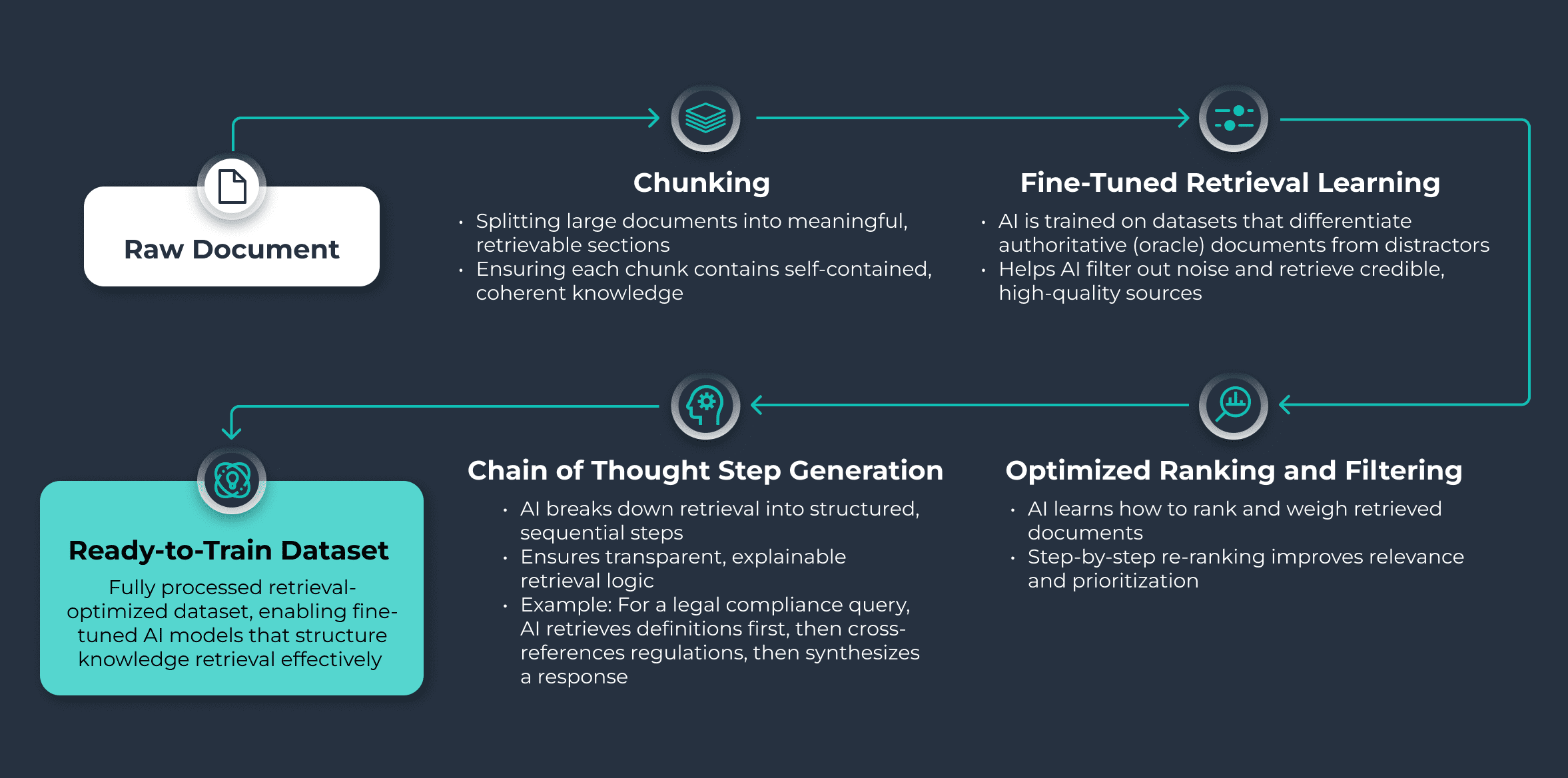
Fine-tuned retrieval learning
AI is trained on datasets that differentiate authoritative (oracle) documents from irrelevant (distractor) sources. This step filters out noise, ensuring retrieval is based on high-quality, domain-specific knowledge.
Optimized ranking and filtering
AI doesn’t retrieve documents on its own—it relies on a retrieval system to surface relevant information. What AI does is learn how to weigh, filter, and synthesize that information based on relevance, authority, and task-specific needs. Enhanced retrieval optimizes this process by ensuring AI receives structured, high-quality knowledge, reducing reliance on raw retrieval alone.
Structured retrieval with chain of thought processing
Once relevant documents are retrieved, AI organizes them into logical steps, mirroring human-like problem-solving. AI processes, ranks, and structures retrieved knowledge in a sequence that enhances decision-making and interpretability.
For example, if a user asks about a legal compliance policy, AI first retrieves legal definitions, then cross-references relevant clauses, and finally synthesizes a structured response with supporting sources.
The role of dataset generation in Enhanced Retrieval
For AI to effectively prioritize, rank, and structure retrieved knowledge, it must be trained on high-quality retrieval datasets. The dataset generation process ensures AI:
- Learns to distinguish relevant from irrelevant information, filtering out non-authoritative sources.
- Understands how to rank and re-rank retrieval results, optimizing for clarity and precision.
- Processes information step-by-step using Chain of Thought reasoning, structuring retrieval logically.
By training AI on retrieval optimized datasets, we ensure that it doesn’t just find related information— it structures knowledge in a way that supports more accurate and context-aware decision-making.
Why Enhanced Retrieval is a step beyond traditional RAG
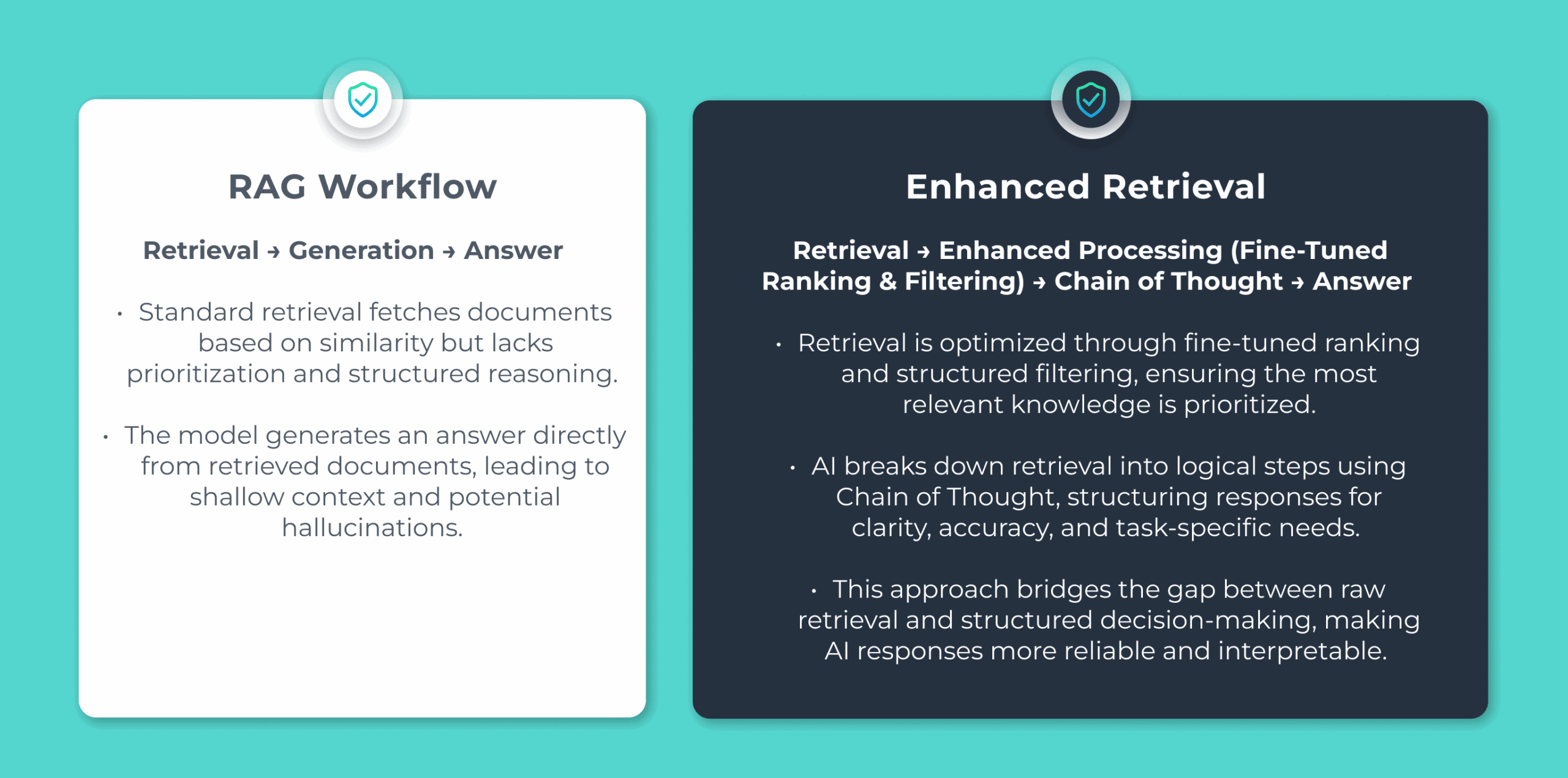
Unlike standard RAG, which simply fetches relevant documents and passes them to an LLM, enhanced retrieval actively improves the retrieval process itself.
- Retrieval isn’t just about finding documents—it’s about organizing and structuring knowledge for decision-making.
- Step-by-step retrieval ensures AI selects, ranks, and structures responses logically.
- This approach bridges the gap between raw search and structured knowledge retrieval, making AI more effective for reasoning, compliance, and complex workflows.
How Enhanced Retrieval powers smarter AI workflows
As AI applications become more advanced, they must do more than simply retrieve relevant documents—they need to retrieve structured, prioritized, and context-aware knowledge that aligns with specific tasks. Enhanced retrieval bridges the gap between raw search and intelligent knowledge selection, ensuring AI retrieves information in a way that supports structured reasoning and decision-making.
By fine-tuning retrieval itself, AI moves beyond generic relevance-based search and becomes task-aware and goal-driven, optimizing knowledge selection for the specific outcome AI is being trained for.
1. Compliance and regulation: Retrieval with traceability
- AI retrieves regulatory clauses with greater precision rather than returning entire legal documents.
- Research suggests that structured retrieval can reduce regulatory compliance errors, making AI systems more trustworthy in legal applications (LexNLP, 2023).
2. Enterprise knowledge: Context-aware internal AI
- AI assistants trained on enhanced retrieval show improved document ranking and relevance filtering compared to generic RAG models.
- Studies on corporate AI assistants indicate that enhanced retrieval reduces employee search time and improves knowledge discovery (MIT AI Enterprise Study, 2023).
3. Research and search: Smarter knowledge discovery
- Enhanced retrieval helps reduce irrelevant search results, leading to higher-quality AI-generated research outputs.
- Models trained with task-specific retrieval filtering have demonstrated increased retrieval precision in scientific literature search and research applications (OpenAI Retrieval Study, 2023).
These improvements demonstrate real-world impact, making AI retrieval more precise, structured, and goal-driven for decision-making applications.
Enhanced Retrieval vs. standard RAG
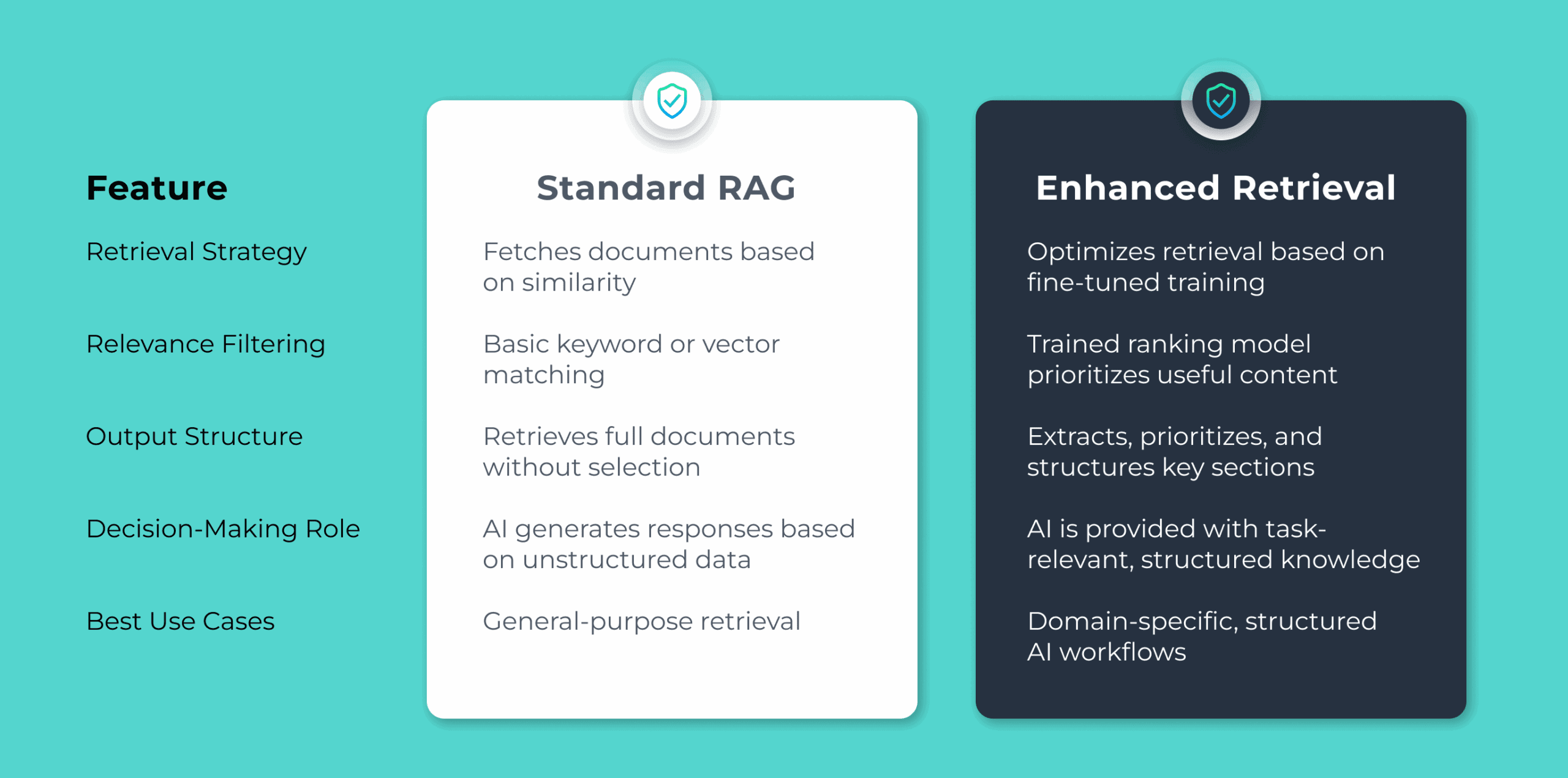
Rather than retrieving “useful enough” documents, enhanced retrieval ensures AI retrieves information that is structured for the task at hand.
Final thoughts
AI is evolving rapidly, with research shifting toward reasoning models, multi-step workflows, and agentic systems. These advancements promise more autonomous, structured, and adaptable AI, but they introduce a key challenge: they depend on retrieval that is optimized for context, prioritization, and structured knowledge access.
- Retrieval is no longer just a step—it defines the quality of AI reasoning.
- Recent benchmarks confirm that retrieval quality is one of the biggest drivers of AI accuracy and reliability.
- Enhanced retrieval ensures AI retrieves, structures, and applies information with precision—because better retrieval leads to better decisions.
As AI systems grow more complex, retrieval must evolve alongside them. Enhanced retrieval is the foundation for making AI more explainable, reliable, and intelligent.
How we do it at Seekr
At Seekr, we are one of the few companies capable of making enhanced retrieval a reality. Our AI-Ready Data Engine plays a crucial role in this process, ensuring that AI retrieves structured, context-aware knowledge that supports decision-making.
How the AI-Ready Data Engine powers Enhanced Retrieval
- High-quality training data: Our AI-Ready Data Engine generates optimized training datasets that teach models to differentiate between authoritative and non-authoritative sources.
- Retrieval-aware fine-tuning: Seekr fine-tunes retrieval models with structured knowledge workflows, ensuring AI retrieves, ranks, and structures knowledge effectively.
- Step-by-step knowledge structuring: Using chain-of-thought retrieval, our system ensures that AI doesn’t just fetch data—it organizes and presents it in a way that enhances reasoning and decision-making.
Seekr’s AI-Ready Data Engine enables true enhanced retrieval, ensuring AI doesn’t just retrieve information—it retrieves the right information, structured for the task at hand.
Citations & References
- Meta AI (2023). Retrieval Optimization and Hallucination Prevention in Large Language Models. Retrieved from Meta AI Blog.
- Stanford HAI (2023). The Role of Retrieval in Trustworthy AI Systems. Stanford Human-Centered AI Institute.
- Google DeepMind (2022). Improving Open-Domain Question Answering via Optimized Document Retrieval. DeepMind Research Papers.
- Harvard NLP (2023). Challenges in Knowledge-Intensive NLP: A Study on Retrieval-Based AI Models. Harvard NLP Group.
- LexNLP (2023). Structured Legal Retrieval for Compliance Applications. Retrieved from LexNLP.
- MIT AI Enterprise Study (2023). AI-Powered Assistants and the Impact of Fine-Tuned Retrieval on Corporate Knowledge Management.
- OpenAI Retrieval Study (2023). Task-Specific Filtering and Contextual Augmentation in AI Search Systems. OpenAI Research.



Accelerate your path to AI impact
Book a consultation with an AI expert. We’re here to help you speed up your time to AI ROI.
Request a demo