Back to Case Studies
Energy company automates invoicing for up to 15,000 loads a month

Turning bills of lading from terminals, carriers, and railcars into invoices, with the source document behind every transaction
Case study at a glance
Customer: A privately held liquid fuels marketing and logistics company with more than 30 years in business
Industry: Energy – liquid fuels marketing, logistics, and trading
Challenge: Bills of lading from dozens of terminals and carriers, in inconsistent formats, had to be read before any load could be invoiced
Solution: SeekrFlow, with vision AI document ingestion, a knowledge layer AI agents can reason over, and a model-agnostic architecture
Results: In production on 10,000 to 15,000 bills of lading a month, with $1.5 million to $2.5 million in potential annual savings
The customer
Our customer is a privately held liquid fuels marketing and logistics company headquartered in Texas. It markets and distributes domestic and export ethanol, crude oil, diesel, and low carbon fuels, along with tradable regulatory compliance credits, to distributors and consumers around the world.
Its product moves by truck, barge, vessel, and rail. The company runs a North American fleet of thousands of railcars, schedules tens of thousands of truckloads a year, and ships to customers in more than 20 countries. Because it handles regulated fuels and compliance credits such as Renewable Identification Numbers (RINs) and Low Carbon Fuel Standard (LCFS) credits, the numbers in its books have to hold up. Every volume it bills has to tie back to a document that proves it.
The challenge
Every physical movement in liquid fuels generates a bill of lading (BoL). The BoL records what shipped, from where, in what quantity, and under whose custody. A load can’t be invoiced until someone captures that information.
The bottleneck was never the invoice. It was reading the document. BoLs arrive from dozens of terminals and carriers as scans, photographs, faxes, and formats vary by origin and by mode. Until someone reads one, no invoice exists.
Before Seekr, people did that reading by hand, document by document. At 10,000 to 15,000 movements a month, the work became a persistent bottleneck between completing a load and getting paid, and answering a question about any past load meant manually finding the original paperwork and interpreting it again.
Speed alone wouldn’t solve it. Finance couldn’t accept an extracted number, it couldn’t trace back to its source. When a volume was questioned, the team needed to see the document behind the number, not just the number. The customer also had a strategic constraint. It had spent two and a half years evaluating the market and didn’t want to lock itself into one model or bet on which technology would win in a market changing by the day.
The approach
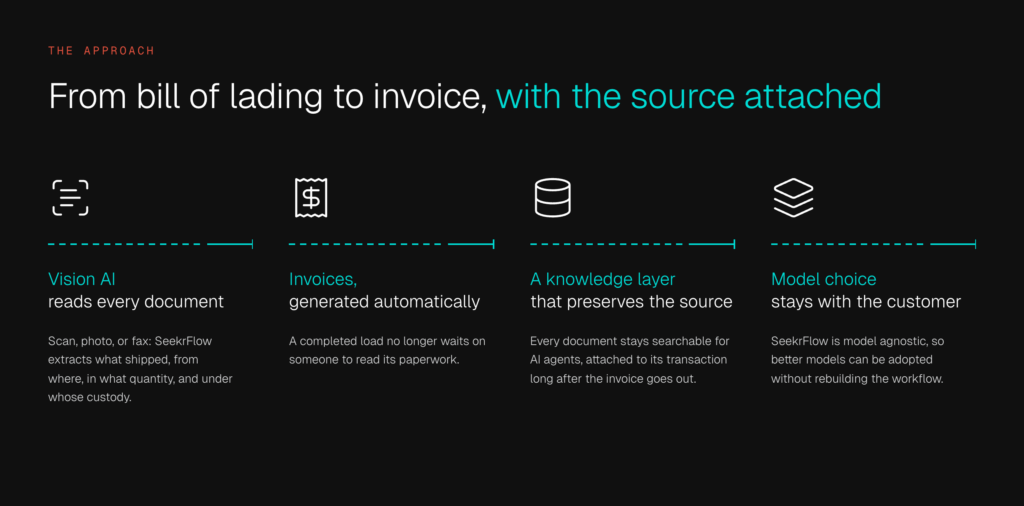
Vision AI that reads every document
SeekrFlow uses vision AI to ingest and understand each BoL, whether it arrives as a scan, a photo, or a fax, and extracts the data required for billing: what shipped, from where, in what quantity, and under whose custody.
Automatic invoice generation
The extracted data generates invoices automatically, so a completed load no longer waits on someone to read its paperwork.
A knowledge layer that preserves the source
Every document is added to a searchable, natural language knowledge layer that AI agents can reason over. The source context behind each transaction stays attached to it, long after the invoice goes out.
Model choice stays with the customer
SeekrFlow is model agnostic. The customer uses the models that make the most sense for its business and can adopt better ones as the market evolves, without rebuilding the workflow.
The results
The solution, built on SeekrFlow, is in production, not a pilot. It runs the customer’s revenue cycle, processing between 10,000 and 15,000 BoLs a month across truck, barge, vessel, and rail. The customer estimates $1.5 million to $2.5 million a year in potential savings from costs it no longer has to incur.
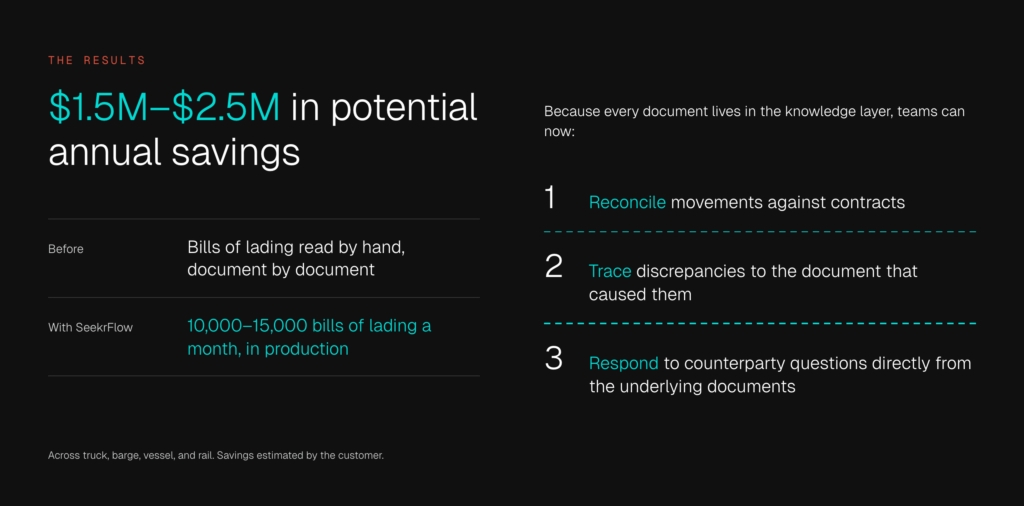
Because every document lives in the knowledge layer, the customer’s teams can now reconcile movements against contracts, trace discrepancies to the document that caused them, and respond to counterparty questions directly from the underlying documents, without manually searching for and interpreting the original paperwork. The result is a faster revenue cycle and a higher level of service to the customer’s own customers.
Why it worked
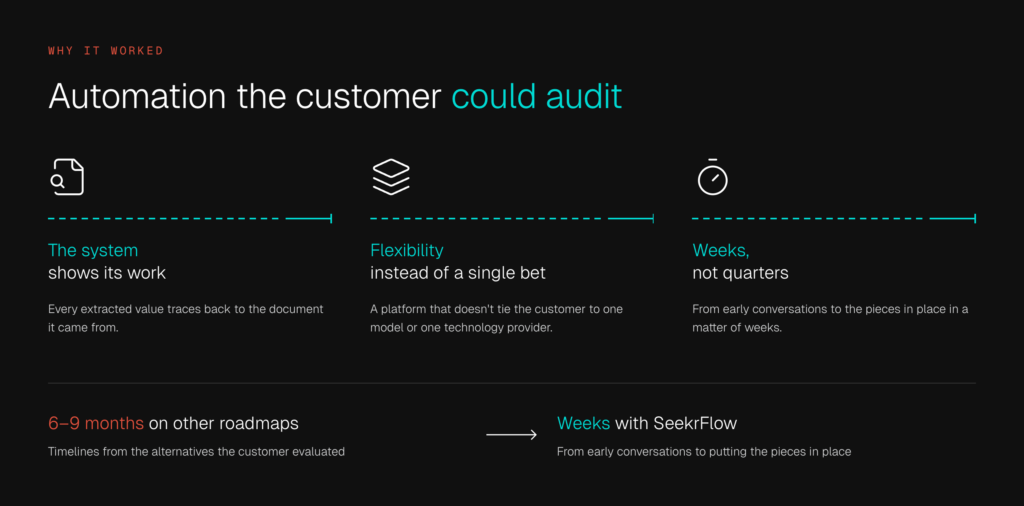
The system shows its work. The customer chose automation it could audit. Every extracted value traces back to the document it came from, which is the only kind of automation a company
handling regulated fuels and compliance credits can put into its books.
Flexibility instead of a single bet. After two and a half years of evaluating the market, the customer chose a platform that wouldn’t tie it to one model or one technology provider.
Weeks, not quarters. The customer went from early conversations to putting the pieces in place in a matter of weeks. Other roadmaps it evaluated ran six to nine months.
None of this is specific to fuels. Any business that runs on high volumes of inconsistent physical documents, from freight to agriculture to industrial distribution, faces the same gap between the work being done and the paperwork that proves it.
What’s next
Because the platform is model agnostic, the customer can adopt new models as they mature instead of re-platforming each time the market shifts. And with every BoL already in a
searchable knowledge layer, each new workflow starts from documents that are already read, structured, and traceable to their source.
Related resources
View all resources

Accelerate your path to AI impact
Book a consultation with an AI expert. We’re here to help you speed up your time to AI ROI.
Request a demo