Back to Blogs
The Shelf Is the Edge
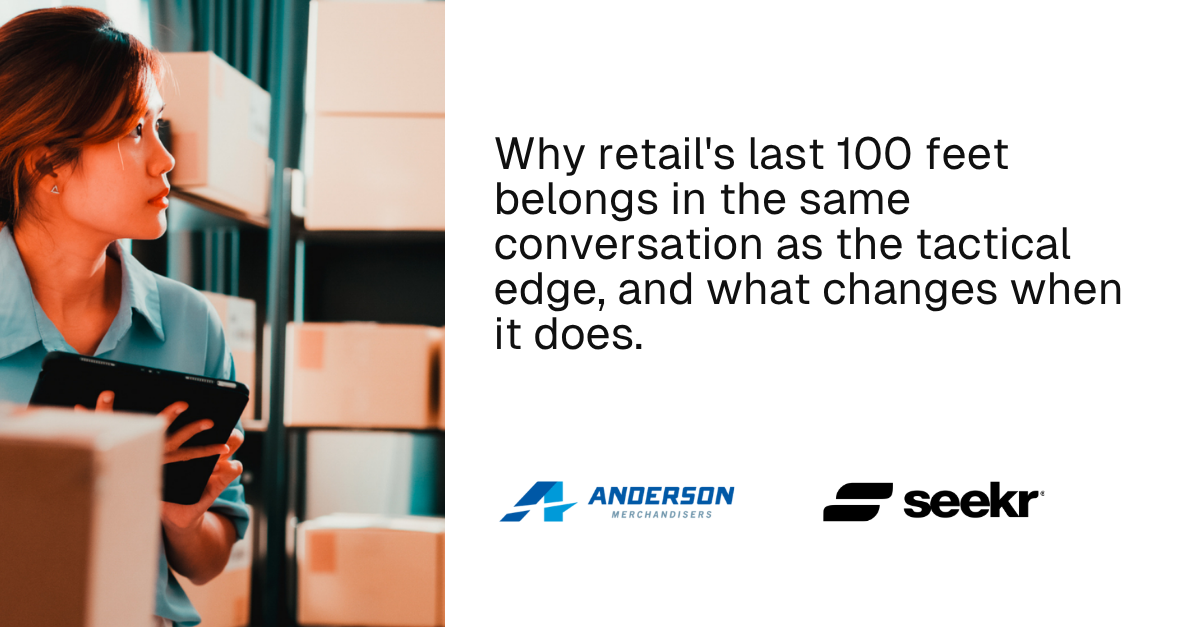

Anderson Merchandisers, the nation’s leading in-store retail services provider, has named Seekr its enterprise AI partner. The partnership will start with the last 100 feet of retail: the shelves, endcaps, and aisles where Anderson’s 4,000+ associates work every day. By putting Seekr’s explainable AI and Vision Language Models (VLMs) directly into associates’ hands, Anderson can turn each store visit into actionable intelligence and every shelf into a measurable performance surface for the consumer packaged goods brands it serves.
Read the full press release HERE.
For about twenty years, “the edge” has been a defense and tech term. It describes the forward-deployed place where data is generated, latency is unforgiving, connectivity can fail, and decisions can’t wait for headquarters. Tactical edge. Edge computing. Edge AI. The vocabulary developed in places where the consequences of a slow decision are measured in seconds: battlefield ISR, autonomous platforms, industrial control systems in remote sites.
Retail has been describing the same kind of place for years without using the word.
When a merchandiser walks into a big-box store on a Tuesday morning to reset an endcap, the conditions they’re working in would look familiar to a tactical edge architect. Cellular signal is spotty in the back of the store. The wifi may or may not be theirs to use. The decision window is now. The shopper rounding the corner is going to make a buying choice in the next thirty seconds based on what they see. The data the merchandiser is generating—a photo of the shelf, a count of facings, a note on a competitor’s promotion—is locally relevant and time-sensitive. And the consequence of getting it wrong shows up immediately, in revenue, in trade investment, in a brand’s quarterly category report.
That’s an edge environment. We just haven’t called it one.
What “the edge” actually means
Across the domains that have used the term longest, the edge has four consistent properties.
It’s where the data is born. Sensors, cameras, devices, and people generate signal at the edge before any of it reaches a data center.
It’s where latency matters. The round-trip to a cloud is too slow for the decision the operator needs to make. Whether that’s a drone rerouting around a threat, a turbine adjusting load, or an associate restocking before the lunch rush, the decision has to happen locally.
It’s where connectivity is degraded, contested, or denied. Defense calls this “DDIL”: disconnected, denied, intermittent, or limited. In retail, it’s a basement aisle, a back room, a parking lot. Same problem, different vocabulary.
And it’s where the decision has consequence. Edge environments are defined by the fact that the operator at the edge has authority and responsibility. They’re not just collecting data for someone else to act on later.
Run that list against a retail merchandiser’s day and every line checks. The 4,000+ Anderson Merchandisers associates working across the US are operating in a distributed, intermittently-connected environment where the data they generate matters most in the moment they generate it, and where the person closest to the decision is the one who has to make it. They’re edge operators. The shelf is the edge.
Why the reframe matters
This isn’t a metaphor for its own sake. Naming the shelf as edge changes what we should be building for it.
The dominant approach to AI in retail for the last decade has been cloud-first: capture data in the field, ship it to a data lake, run analytics, push insights back out the next day or the next quarter. For long-cycle questions—assortment planning, demand forecasting, category strategy—that loop is fine. For the moments that actually happen in front of a shopper, it’s far too slow. By the time yesterday’s audit becomes next week’s recommendation, the sale is gone, the trade investment is spent, and the empty shelf has done its damage.
Edge AI changes the math in three ways.
- The decision happens locally, in seconds, on the device the associate already has in their hand. The associate captures a shelf, the model sees what’s wrong, the recommendation comes back before they’ve moved to the next aisle. Same-visit correction, not next-day reporting.
- The system works whether or not connectivity does. A model running on the device doesn’t care if the wifi drops or the cellular bar disappears. In retail, this is the difference between a tool that gets used and a tool that gets abandoned the third time it fails in a back aisle.
- And the data stays where it should. Brands and retailers are increasingly cautious about where shelf imagery, planogram data, and store conditions live. Edge deployment keeps that data on the device or in the customer’s environment, not aggregated into a third-party cloud where the data ownership questions get hard.
That’s why the AI capability that wins the shelf is going to look more like the AI capability that wins a forward-deployed mission than it looks like a SaaS analytics dashboard. Same architectural principles, different theater.
What it does for the people
The most interesting consequence of treating the shelf as an edge environment is what it does for the people working there.
For most of the last twenty years, the merchandiser’s job has been front-loaded with data collection: walk the aisle, fill out the form, take the photo, file the report. The judgment work has lived back at headquarters with analysts who get the data days later, stripped of context.
When the AI runs at the edge, that flips. The data work compresses to seconds. The judgment work moves forward, to the person standing in the aisle. Associates with edge AI in their pocket aren’t doing more clipboard work; they’re doing less of it. What they’re doing more of is deciding. Which fix, which conversation with the store manager, which escalation to the brand. That’s a more skilled job, not a less skilled one. It’s the same shift that happened when tactical edge computing put real intelligence in the hands of forward-deployed operators instead of asking them to radio every observation back to a command post.
The most credible edge AI deployments—in defense, in industrial, and now in retail—are the ones that augment the people at the edge rather than try to replace them. The edge is the place where context, judgment, and improvisation matter most, and those are the things humans are still better at than models. What edge AI does is take the rote work off the operator’s plate so they can spend their time on the part of the job that actually requires a person.
The next decade of retail will be won at the edge
Retail has been talking about omnichannel for 15 years and frictionless commerce for the last 10. Both of those vocabularies were borrowed from tech and made retail’s challenges legible to people who hadn’t worked the floor.
“The edge” is the next borrowed word, and it’s a more precise one. It names what’s actually different about working in front of a shelf versus working in a spreadsheet. It puts the right architectural questions—latency, connectivity, autonomy, data sovereignty—in front of the people designing tools for the floor. And it suggests that the AI capability the industry needs isn’t a smarter dashboard at the headquarters but a smarter set of eyes and hands in the aisle.
The companies that figure this out first will protect more trade investment, lose fewer sales to empty shelves, and build a frontline workforce that’s harder to replicate.
The shelf is the edge. And the edge is where Seekr does its best work.
This is the work Seekr is built for. The same explainable AI, edge deployment, and Vision Language Models that have earned trust in some of the most demanding environments in enterprise and government are now in the hands of the people standing in front of the shelf. Not a dashboard at headquarters. Not a report next quarter. Real intelligence, on the device, in the moment a decision actually has to be made.
Our work has always been about getting the right product to the right place at the right time, every time. What has changed is the level of precision and speed that ‘every time’ now demands. Our associates are the best in the industry, and they deserve technology that matches their expertise. Seekr brings exactly what modern retail execution requires: advanced vision-language models, industry-specific intelligence, and edge deployment capabilities that operate where the work happens. The AI sees what our associates see and provides clear, actionable guidance on where to focus. That’s the difference between simply auditing the shelf and actively improving it.”
Jeff King, President of Anderson Merchandisers
Explore more resources
View all resources
Accelerate your path to AI impact
Book a consultation with an AI expert. We’re here to help you speed up your time to AI ROI.
Request a demo