Back to Blogs
What Does It Take for AI to Pass an Audit? Key Takeaways from Money20/20 2026
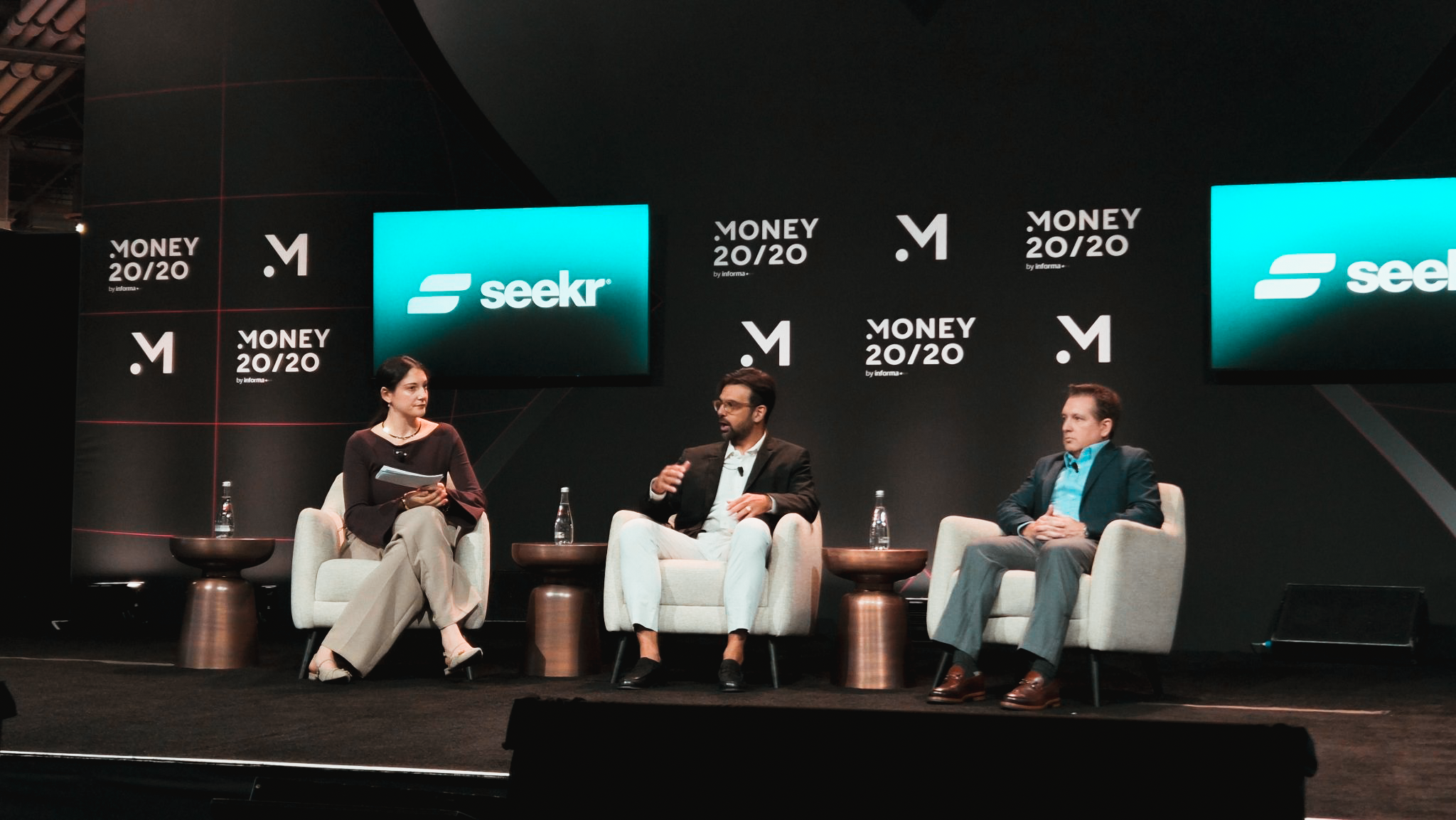

At Money20/20, Seekr Chief Technology and AI Officer Stefanos Poulis joined Stephano Slack’s Jim Forgione for a discussion moderated by CB Insights’ Rachel Binder on what it takes to make AI-generated audit work defensible.
When AI prepares a financial workpaper, an auditor needs to know where the numbers came from, which evidence supports the conclusions, and whether the work can withstand independent review.
These were among the questions explored at this year’s Money20/20 in Las Vegas during Defensible by Design: How Explainable AI Passed the Audit.
Moderated by Rachel Binder, VP of Research & Intelligence at CB Insights, the session featured Stefanos Poulis, Chief Technology and AI Officer at Seekr, and Jim Forgione, Audit & Assurance Lead Partner at Stephano Slack. Together, they discussed their organizations’ work to bring explainable AI into financial auditing and the technical requirements for building AI systems that auditors can trust.
Their conversation highlighted four considerations for organizations deploying AI in high-stakes environments.
AI must meet the standards of the people responsible for its work
Financial auditing requires a rigorous review process. Junior staff prepare workpapers and conduct testing, while managers and partners examine the supporting evidence, verify calculations, and confirm that conclusions meet professional standards.
Introducing AI into this workflow requires the same level of accountability. Over the past year, Seekr and Stephano Slack have worked together to develop AI capabilities for 401(k) auditing, combining Seekr’s AI technology with Stephano Slack’s accounting expertise.
The collaboration focuses on enabling AI agents to support audit workflows while preserving the documentation and review processes auditors depend on. AI-generated workpapers must include accessible source evidence so qualified reviewers can independently verify the results.
This approach places domain experts at the center of AI development, helping ensure the technology meets the requirements of the professionals who will ultimately rely on it.
Explainability is essential to defensible AI decisions
An AI system can produce a convincing answer without providing sufficient evidence to support it. For an auditor, that creates a fundamental problem: How can a reviewer verify a conclusion without understanding the information and processes that produced it?
During the session, Stefanos discussed the different dimensions of explainability, including model, context, and data attribution. These techniques provide visibility into how AI systems reach conclusions, including which sources influenced an answer, what information informed the model’s behavior, and how a particular result was generated.
For AI-assisted auditing, this means establishing an evidence trail that connects the output to the supporting documentation and relevant decision processes.
Explainability is foundational to Seekr’s approach to AI development. By building these capabilities directly into the technologies underpinning its products, Seekr enables organizations to examine AI behavior and evaluate outputs as part of their operational workflows.
Human oversight must extend beyond reviewing the final answer
Even well-designed AI systems can make mistakes. Organizations need the ability to identify errors, challenge conclusions, and take corrective action.
Stefanos emphasized the importance of contestability, which gives users mechanisms to question AI-generated decisions, inspect the supporting evidence, correct errors, and initiate remediation.
Together with evaluation, governance, security, and explainability, these capabilities establish a framework for deploying AI with meaningful human oversight.
For auditing firms, this also has implications for workforce development. As AI assumes more responsibility for repetitive tasks, accounting professionals will need to strengthen their analytical judgment and critical review skills. Human expertise remains central to evaluating the quality of work and determining whether conclusions are justified.
AI sovereignty gives organizations greater control over their investments
As enterprises develop AI capabilities around proprietary data and specialized workflows, ownership and control become increasingly important.
The discussion addressed a fundamental consideration for organizations investing in AI: Do you want to rent or own your intelligence?
For firms handling sensitive financial information, the answer affects data security, intellectual property, infrastructure decisions, and long-term operating costs. Seekr’s approach to AI sovereignty enables organizations to maintain control over their data, models, and deployment environments. Its infrastructure- and hardware-agnostic architecture supports deployment across cloud, on-premises, and edge environments, while open-weight models offer opportunities to optimize performance and cost for specialized use cases.
For Stephano Slack, this flexibility creates opportunities to build proprietary AI capabilities around its accounting expertise, with the potential to commercialize those capabilities in the future. Organizations can develop AI systems that reflect their specific requirements while retaining greater control over how those systems operate and evolve.
Building a foundation for AI in high-stakes environments
The requirements discussed at Money20/20 extend across financial services and other regulated industries. Whether AI is supporting financial audits, credit decisions, risk assessments, or compliance workflows, organizations need systems that deliver reliable results and provide the evidence required to verify them. That means prioritizing explainability, data sovereignty, governance, security, and human oversight alongside model performance.
The Seekr and Stephano Slack collaboration demonstrates how these principles can be applied to specialized, high-stakes workflows, creating opportunities to expand AI adoption while preserving the accountability those environments demand. When organizations can examine, verify, and challenge AI-generated work, they gain greater control over the decisions they entrust to AI.
Ready to build AI you can trust, explain, and defend?



Accelerate your path to AI impact
Book a consultation with an AI expert. We’re here to help you speed up your time to AI ROI.
Request a demo